



















- Industrial display
-
Industrial Products
- DC Servo Drive
- AC Servo Drive
- Industrial board
- Siemens
- Switch Sensor
- Proximity Switch
- Temperature Controller
- Protection Relay
- Fiber Optic Sensor
- Encoder
- Fan
- other
- Heidelberg
- MITSUBISHI
- FANUC
- Siemens adapter
- Fujitsu connector
- Motherboard
- Board
- Contactor
- Circuit
- OMRON
- Relay
- Motor Driver
- power supply
- Cable
- Transformer
- HMI Touch Glass
-
HMI Full Machine Whole unit
- OMRON HMI Touch Panel
- Siemens HMI Touch Panel
- Mitsubishi HMI Touch Panel
- Allen-Bradley automation HMI Touch Panel
- DELTA HMI Touch Panel
- Proface HMI Touch Panel
- KINCO DELTA HMI Touch Panel
- HITECH HMI Touch Panel
- WEINTEK HMI Touch Panel
- TECVIEW HMI Touch Panel
- WEINVIEW HMI Touch Panel
- PANASONIC HMI Touch Panel
- KYOCERA HMI Touch Panel
- SCHNEIDER HMI Touch Panel
- Module
- lcd inverter
- Membrane Keypad Switch
- Zhiyan Customized Touch Screens
- Frequency Inverter
- Servo Motor
- PLC
In the intricate world of electronic displays, the choice of a core component like an LCD module can define the performance, reliability, and user experience of an entire device. This article delves into a detailed examination of the G070ACE-L01, a 7-inch a-Si TFT-LCD module manufactured by Innolux. With a resolution of 800(RGB)×480, this specific LCM (LCD Module) represents a critical solution for a wide array of industrial, automotive, and consumer applications where clarity, durability, and consistent performance are non-negotiable.
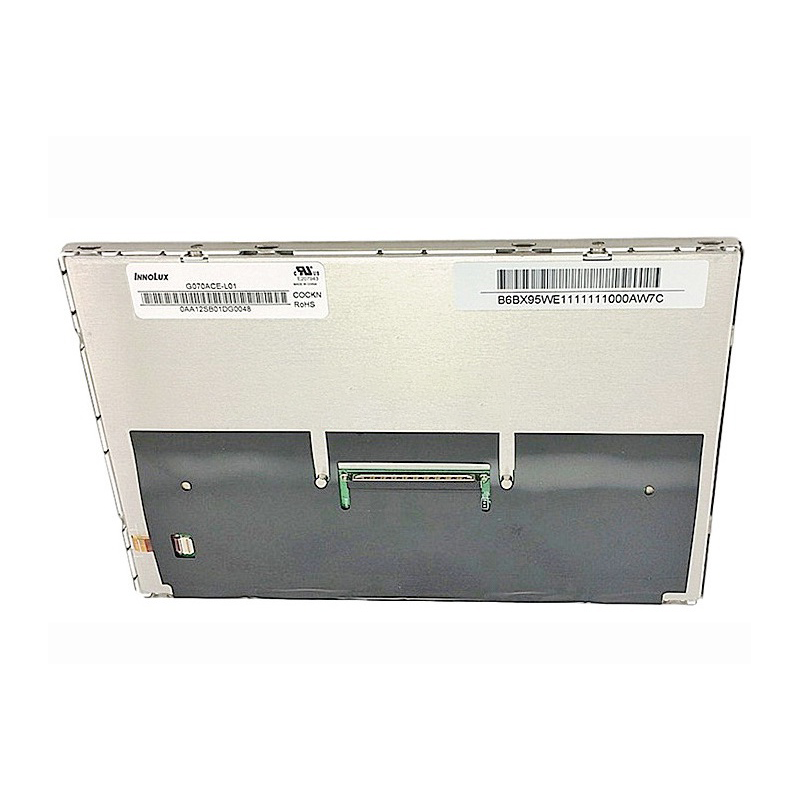
Beyond mere specifications, understanding this module requires a deep dive into its technological underpinnings, its integration challenges, and its competitive positioning in the market. We will explore not just what the G070ACE-L01 is, but why its design choices matter for engineers, product designers, and procurement specialists. From its amorphous silicon TFT backbone to its environmental robustness, this analysis aims to provide a comprehensive resource for professionals evaluating display technologies for their next-generation projects.
Decoding the Core Technology: a-Si TFT and 800×480 Resolution
The foundation of the G070ACE-L01 lies in its use of amorphous Silicon (a-Si) Thin-Film Transistor technology. a-Si TFT is a mature, cost-effective, and highly reliable process for controlling individual pixels on an LCD. Each pixel is governed by its own TFT switch, allowing for precise and rapid manipulation of light transmission. This technology offers an excellent balance between performance, manufacturing yield, and price, making it a staple for mid-sized displays requiring stable operation over long periods
The module's 800 horizontal by 480 vertical pixel arrangement is a defining characteristic. This resolution, often associated with the WVGA (Wide Video Graphics Array) standard, provides a widescreen 15:9 aspect ratio. For a 7-inch diagonal screen, this results in a pixel density that is sufficient for displaying detailed graphics, user interface elements, and readable text without excessive power consumption or data processing overhead. It strikes a practical balance, offering clear imagery for human-machine interfaces (HMIs) and instrumentation while remaining compatible with standard controller ICs and interfaces.
Innolux's Engineering: Module Construction and Key Features
Innolux integrates the TFT cell into a complete LCM (LCD Module), which includes the driving circuitry, backlight unit, and connectors. The G070ACE-L01 typically features a compact, robust mechanical design tailored for direct integration into end products. A critical component is the LED backlight system, which provides uniform brightness across the viewing area. These LEDs are chosen for their longevity and efficiency, often arranged in an edge-lit configuration to minimize thickness.
Key operational features include a specified range of brightness (typically several hundred nits), ensuring visibility in various ambient lighting conditions, and a selection of contrast ratios to deliver deep blacks and bright whites. The module supports a standard RGB interface, accepting digital video signals directly from a host processor or controller. Furthermore, Innolux designs these modules with electromagnetic compatibility (EMC) and signal integrity in mind, reducing noise and interference that could affect sensitive surrounding electronics.
Interface and Integration: Connecting to the System
Successful implementation of the G070ACE-L01 hinges on a clear understanding of its interface protocol. The module utilizes a parallel RGB digital interface, which transmits pixel clock, synchronization signals (HSYNC, VSYNC), data enable (DE), and 24-bit color data (8 bits per Red, Green, and Blue channel). This interface is ubiquitous and well-supported by most application processors and display controllers, simplifying driver development.
For integrators, the physical connector type (such as FPC - Flexible Printed Circuit) and pinout are crucial for designing the mainboard's layout. Power supply requirements are another vital consideration; the module needs precise voltage rails for the logic driver and the LED backlight. Designers must account for inrush current, power sequencing, and potential need for a dedicated LED driver circuit to manage backlight intensity through PWM (Pulse Width Modulation) dimming, a common feature for brightness control.
Application Landscape: Where the G070ACE-L01 Excels
The technical profile of this Innolux module makes it a versatile contender in several demanding markets. In the industrial automation sector, it is ideal for factory HMIs, PLC operator panels, and test equipment, where its reliability and wide operating temperature range ensure continuous operation. The automotive aftermarket and specific non-critical in-vehicle systems utilize such displays for infotainment heads-up units, rear-seat entertainment, or diagnostic tools.
Furthermore, it finds a home in point-of-sale (POS) systems, kiosks, handheld terminals, and various home appliance control panels. In these applications, the 7-inch size offers ample space for interactive menus and information display, while the WVGA resolution is perfectly adequate. Its robustness against temperature fluctuations and potential moisture (depending on specific model variants) makes it suitable for environments beyond a controlled office setting.
Comparative Analysis: Positioning in the Display Market
When evaluated against alternatives, the G070ACE-L01's position becomes clear. Compared to newer IPS (In-Plane Switching) panels, its viewing angles and color vibrancy may be more limited, but it retains advantages in cost and power efficiency for applications where extreme viewing angles are not paramount. Against smaller or lower-resolution modules, it offers superior information density and user experience.
Its primary competition comes from other a-Si TFT modules in the same size and resolution class from manufacturers like AUO or Tianma. Here, the decision factors shift to parametric details: specific brightness levels, contrast ratio, exact interface timing, mechanical dimensions, and of course, price and availability. Innolux's strength lies in its large-scale manufacturing capability and proven supply chain, offering a dependable, well-characterized component for volume production.
Design Considerations and Long-Term Reliability
Integrating the G070ACE-L01 into a product requires careful planning for long-term success. Thermal management is essential; while the module itself is designed to operate within a specified temperature range, the system design must ensure adequate heat dissipation from the backlight and drivers to prevent premature aging. Mechanical stress on the connector and the glass substrate must be minimized through proper mounting and strain relief.
From a supply chain perspective, evaluating the long-term availability (LTA) of the module is critical for products with multi-year lifecycles. Understanding Innolux's product lifecycle roadmap helps avoid last-minute redesigns. Finally, designing for testability and serviceability—such as making the display accessible for replacement—can significantly reduce warranty and repair costs over the product's lifetime, making the initial integration effort a worthwhile investment.
FAQs: G070ACE-L01 Innolux 7" LCD Module
Q1: What does "a-Si TFT-LCD" stand for?A1: It stands for amorphous Silicon Thin-Film Transistor Liquid Crystal Display, a common and reliable technology for controlling display pixels.
Q2: What is the screen resolution of the G070ACE-L01?A2: The resolution is 800 pixels horizontally by 480 pixels vertically, known as WVGA.
Q3: What type of interface does this module use?A3: It uses a standard parallel RGB digital interface with 24-bit color depth.
Q4: What are typical applications for this display?A4: Common applications include industrial HMIs, automotive aftermarket devices, POS systems, kiosks, and appliance control panels.
Q5: What is the role of the LCM designation?A5: LCM means LCD Module, indicating it's a complete unit with the panel, driver ICs, backlight, and connector ready for system integration.
Q6: Can the display brightness be controlled?A6: Yes, brightness is typically controlled via PWM (Pulse Width Modulation) dimming on the LED backlight power line.
Q7: How does it compare to an IPS display?A7: It may have narrower viewing angles and less vibrant color than IPS, but it is generally more cost-effective and power-efficient.
Q8: What are key power supply considerations?A8: Designers must provide stable voltage rails for the logic and the LED backlight, managing inrush current and power sequencing.
Q9: Is this module suitable for outdoor use?A9: Standard versions are for indoor use. Outdoor use requires checking for specific high-brightness (>1000 nits) and ruggedized variants, which may have a different model number.
Q10: Where can I find the detailed datasheet and pinout?A10: The official datasheet and pinout diagram should be obtained directly from Innolux or an authorized distributor for accurate and up-to-date specifications.
Conclusion
The Innolux G070ACE-L01 7-inch a-Si TFT-LCD module exemplifies a mature, optimized display solution that continues to power a vast ecosystem of digital devices. Its value proposition is built on a foundation of proven a-Si TFT technology, a practical WVGA resolution, and Innolux's integrated module manufacturing. For engineers and product managers, its significance lies not in being the most advanced display available, but in being a reliable, well-understood, and cost-effective workhorse for applications where consistent performance and straightforward integration are paramount.
Selecting a display module is a strategic decision that impacts hardware design, software development, supply chain logistics, and end-user satisfaction. By thoroughly understanding the capabilities, integration requirements, and ideal use cases of components like the G070ACE-L01, development teams can make informed choices that enhance product robustness, streamline production, and ultimately deliver a superior and dependable user interface to the market.





