
















- Industrial display
-
Industrial Products
- DC Servo Drive
- AC Servo Drive
- Industrial board
- Siemens
- Switch Sensor
- Proximity Switch
- Temperature Controller
- Protection Relay
- Fiber Optic Sensor
- Encoder
- Fan
- other
- Heidelberg
- MITSUBISHI
- FANUC
- Siemens adapter
- Fujitsu connector
- Motherboard
- Board
- Contactor
- Circuit
- OMRON
- Relay
- Motor Driver
- power supply
- Cable
- Transformer
- HMI Touch Glass
-
HMI Full Machine Whole unit
- OMRON HMI Touch Panel
- Siemens HMI Touch Panel
- Mitsubishi HMI Touch Panel
- Allen-Bradley automation HMI Touch Panel
- DELTA HMI Touch Panel
- Proface HMI Touch Panel
- KINCO DELTA HMI Touch Panel
- HITECH HMI Touch Panel
- WEINTEK HMI Touch Panel
- TECVIEW HMI Touch Panel
- WEINVIEW HMI Touch Panel
- PANASONIC HMI Touch Panel
- KYOCERA HMI Touch Panel
- SCHNEIDER HMI Touch Panel
- Module
- lcd inverter
- Membrane Keypad Switch
- Zhiyan Customized Touch Screens
- Frequency Inverter
- Servo Motor
- PLC
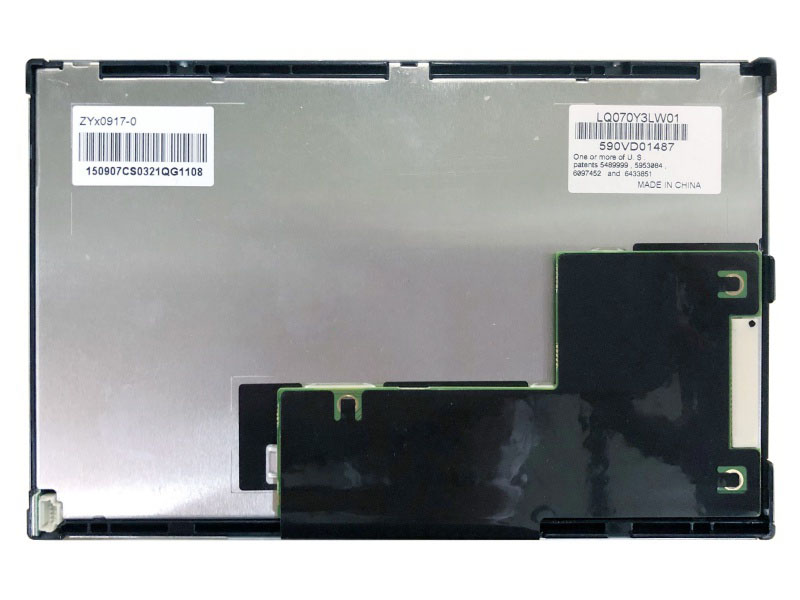
In the intricate world of electronic components, the choice of a display screen can define the performance, reliability, and user experience of a device. For engineers, product designers, and procurement specialists working with specific Sharp models, identifying the exact compatible part is paramount. This article delves deep into the LQ070Y3LW01, a 7-inch LCD display module from Sharp, exploring its technical DNA and practical applications.
Beyond a simple part number, the LQ070Y3LW01 represents a specific solution for a range of embedded visual interfaces. We will dissect its core specifications, from its resolution and brightness to its interface and power requirements. Furthermore, we will examine its typical integration scenarios, key advantages it offers over generic alternatives, and crucial considerations for sourcing and implementing this display in your projects. This guide aims to provide a comprehensive resource for professionals seeking to understand and utilize this precise component effectively.
Decoding the LQ070Y3LW01: Core Specifications and Features
The Sharp LQ070Y3LW01 is a 7-inch diagonal active matrix TFT LCD module designed for industrial and embedded applications. At its heart is an amorphous silicon TFT panel with a native resolution of 800 x RGB x 480 (WVGA). This resolution provides a clear and detailed image suitable for human-machine interfaces (HMIs), portable instruments, and control panels. The module typically incorporates a CCFL backlight system, offering a balanced luminance level, often around 300 cd/m², ensuring readability in various indoor lighting conditions.
Key mechanical specifications include a landscape orientation and defined outline dimensions, crucial for chassis design. The interface is a critical feature; this module commonly uses an LVDS (Low-Voltage Differential Signaling) interface, which provides robust, high-speed data transmission with reduced electromagnetic interference. Understanding these foundational specs—size, resolution, brightness, and interface—is the first step in evaluating its fit for a project, forming the basis for all subsequent integration work.
Typical Applications and Integration Scenarios
Due to its robust design and reliable performance, the LQ070Y3LW01 finds its home in environments where durability and clarity are non-negotiable. A primary application is in industrial human-machine interfaces (HMIs) for factory automation, process control systems, and machinery operator panels. Its screen size offers an optimal balance between information density and physical footprint. Another significant domain is medical and laboratory equipment, such as portable diagnostic devices or monitoring systems, where accurate visual feedback is essential.
Furthermore, this display is well-suited for transportation and fleet management systems, in-vehicle infotainment or control units, and specialized point-of-sale (POS) terminals. Integration involves not just physical mounting but also ensuring compatibility with the host system's video controller (which must support LVDS output), designing the appropriate power supply for both the logic board and the CCFL backlight inverter, and implementing a touch panel overlay if interactive functionality is required.
Advantages Over Generic Display Alternatives
Choosing an OEM-specific module like the LQ070Y3LW01 over a generic 7-inch display offers distinct benefits. The foremost advantage is guaranteed compatibility and performance with the original device's design parameters, ensuring optimal color rendition, timing, and signal integrity. Sharp's manufacturing quality control translates to higher reliability and longevity, a critical factor for products with long lifecycles or those operating in demanding conditions.
From a technical support perspective, having a defined part number provides access to official datasheets and application notes, which detail electrical characteristics, timing diagrams, and recommended connection schematics. This reduces design risk and debugging time. While generic screens may offer superficial similarity in size and resolution, they often lack the rigorous testing and consistent performance of a branded module, potentially leading to issues with image retention, temperature tolerance, or electromagnetic compatibility.
Critical Considerations for Sourcing and Compatibility
Sourcing the LQ070Y3LW01 requires diligence. The market contains new original,refurbished, and compatible versions. For mission-critical applications, new original parts are strongly recommended to ensure full specification compliance. It is vital to verify the exact version and revision, as minor changes in the suffix or manufacturing lot can sometimes imply differences in the backlight type or connector pinout.
Compatibility checks extend beyond the part number. Designers must confirm the interface protocol match (e.g., single-channel LVDS with specific pin mapping), the voltage requirements for logic and backlight, and the mechanical mounting points. Furthermore, one must consider the long-term availability of the module, especially for products requiring ongoing manufacturing or service support for many years, and plan for potential end-of-life (EOL) scenarios.
Implementing the Display: Interface and Power Design
Successful implementation hinges on proper interface and power circuit design. The LVDS interface requires a compatible transmitter on the main controller board. The connection must adhere to the differential pair routing guidelines to maintain signal integrity, including controlled impedance, length matching, and avoiding noise sources. The typical connector type and pin assignment must be followed precisely as per the datasheet.
Power design is twofold. The logic supply (often 3.3V or 5V) must be clean and stable. The CCFL backlight requires a high-voltage AC inverter circuit. This inverter must match the backlight's electrical characteristics (lamp current, striking voltage) to ensure even illumination, long lamp life, and avoid audible noise. In modern designs, there may be considerations for migrating to LED backlighting for lower power consumption, which would involve a different driver circuit entirely.
Maintenance, Troubleshooting, and Longevity
For systems already employing the LQ070Y3LW01, maintenance focuses primarily on the backlight assembly. CCFL tubes have a finite lifespan and will gradually dim over thousands of hours of operation. Common failure modes include a dim screen, screen flicker, or complete backlight failure. Troubleshooting often involves checking the inverter's input voltage, output to the CCFL, and the tubes themselves.
To extend the display's operational life, ensure it operates within its specified temperature and humidity ranges and is protected from physical shock. Image retention can be mitigated by implementing screen savers or power management to turn off the backlight during periods of inactivity. Understanding these aspects is key for field service technicians and for planning the lifecycle management of the end product.
FAQs: LQ070Y3LW01 7" LCD Display Screens for SHARP
1. What is the resolution of the LQ070Y3LW01?It has a WVGA resolution of 800 x 480 pixels.
2. What type of interface does it use?It typically uses an LVDS (Low-Voltage Differential Signaling) interface.
3. Is this a touch screen display?No, the LQ070Y3LW01 is a display module only. A separate resistive or capacitive touch panel can be added.
4. What is the backlight technology?This module originally features a CCFL (Cold Cathode Fluorescent Lamp) backlight system.
5. Can I replace it with any 7-inch LCD?Not directly. Compatibility depends on the interface, voltage, signals, and physical dimensions.
6. Where is it commonly used?In industrial HMIs, medical devices, transportation systems, and specialized POS terminals.
7. What are the main advantages of using this specific part?Guaranteed performance, high reliability, and access to precise technical documentation.
8. What should I check when sourcing a replacement?Verify it's an original Sharp part, check the exact revision, and confirm the backlight type.
9. What causes a dim screen on this module?Most commonly, it's due to aging or failing CCFL backlight tubes or a faulty inverter circuit.
10. How can I extend its lifespan?Operate within specified environmental limits and manage backlight-on time to reduce CCFL wear.
Conclusion
The Sharp LQ070Y3LW01 is far more than a commodity screen; it is a precision-engineered component with defined characteristics that make it the optimal choice for specific embedded visual applications. Its WVGA resolution, LVDS interface, and industrial-grade construction cater to markets where reliability and performance are critical. Understanding its specifications, ideal use cases, and integration requirements is essential for engineers and developers.
Selecting this display necessitates a careful approach to sourcing, a meticulous implementation of interface and power design, and a strategy for long-term maintenance. By appreciating these depths, professionals can leverage the LQ070Y3LW01 to build robust, high-quality products, ensuring a clear and dependable user interface that stands the test of time. In the realm of specialized displays, such informed precision is the key to successful product design and longevity.





