














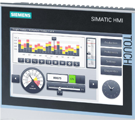






In the intricate world of electronic components, the display often serves as the critical interface between machine and user. For engineers, product designers, and procurement specialists sourcing the right TFT module, the G070VTN03.0 stands out as a significant part number. This 7-inch display module, built around an AUO (AU Optronics) TFT panel, represents a specific convergence of performance, reliability, and application-focused design.
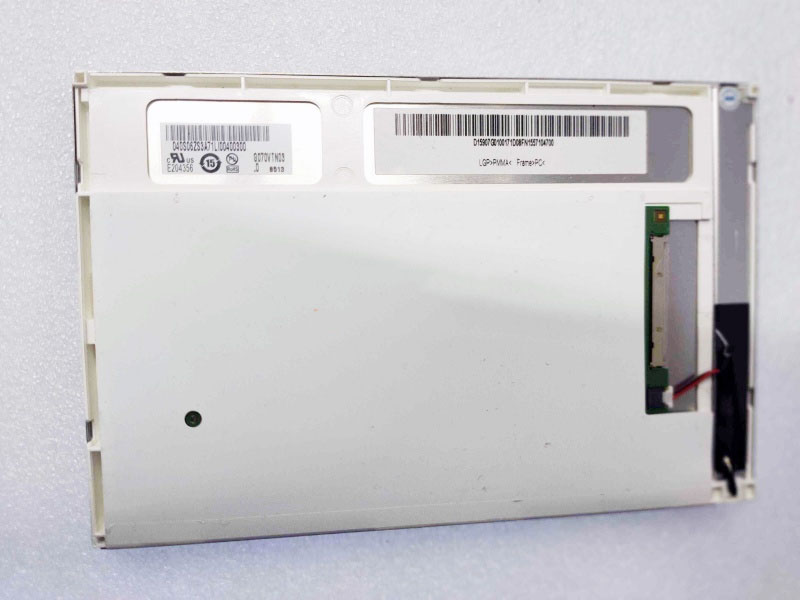
This article delves deep into the G070VTN03.0, moving beyond basic datasheet parameters to explore its technical DNA, competitive advantages, and ideal implementation scenarios. We will dissect its core specifications, interface technology, optical characteristics, and the tangible benefits it brings to various industries. Whether you are evaluating it for a medical device, industrial HMI, or a portable terminal, understanding the nuances of this module is key to unlocking its full potential and ensuring a successful integration into your next-generation product.
Decoding the G070VTN03.0: Core Architecture and Specifications
The G070VTN03.0 is a 7.0-inch diagonal TFT-LCD module utilizing an AUO-produced panel as its core visual engine. Its native resolution is 800 (RGB) x 480 pixels (WVGA), a format that provides a balanced compromise between sharp detail and controller bandwidth requirements. The module typically employs a standard RGB interface, making it compatible with a wide range of mainstream processors and FPGA solutions.
At its heart lies an a-Si (amorphous Silicon) TFT process, known for its cost-effectiveness and maturity in the mid-size display segment. The module is designed with a landscape orientation and features an active area of 154.08mm x 85.92mm, with an overall outline and mounting hole pattern that conform to common industrial form factors. Understanding these foundational specs is crucial, as they dictate the physical and electrical integration parameters, from PCB footprint and power sequencing to the timing controller configuration needed to drive the pixels correctly.
The Optical Performance: Brightness, Contrast, and Viewing Angles
Beyond the digital interface, the visual output defines the user experience. The G070VTN03.0 is engineered for clear readability in various environments. Its typical brightness rating often ranges around 300 to 400 nits, sufficient for indoor use and many controlled-light industrial settings. The contrast ratio, a key factor in image depth and text legibility, is typically specified at a level like 500:1 or higher.
A critical characteristic is its viewing angle performance, based on AUO's panel technology. It generally offers wide viewing angles (e.g., 70/70/50/70 degrees in Left/Right/Up/Down configuration), ensuring the display content remains visible without major color shift or contrast inversion when viewed from oblique angles. This is paramount for devices where the user may not be directly in front of the screen, such as in multi-operator stations or embedded panels.
Interface and Integration: Connecting to Your System
Integration practicality is where component selection meets engineering reality. The G070VTN03.0 commonly features a parallel RGB (TTL) interface. This interface uses multiple data lines (e.g., 24-bit for 16.7M colors) along with standard control signals (HSYNC, VSYNC, DOTCLK, DE). This parallel approach offers low latency and direct compatibility with many embedded CPUs that include a dedicated LCD controller.
The module usually includes a single CCFL or, in more modern versions, an LED backlight unit (BLU) with its associated inverter or driver circuit. The power supply requirements are typically single-supply (e.g., 3.3V or 5.0V for logic, with a separate higher voltage for the backlight). Careful attention to the power-on/off sequencing and signal timing, as per the datasheet, is essential to avoid long-term reliability issues like image retention or stress on the panel drivers.
Robustness and Reliability for Demanding Applications
The value of a display module like the G070VTN03.0 is proven in challenging operating conditions. It is inherently designed for extended product lifecycles and stable performance. The use of industrial-grade components and a robust bonding process for the driver ICs ensures resilience against vibration and thermal cycling.
Its operating temperature range, often specified from -20°C to 70°C or similar, qualifies it for use in non-climate-controlled environments like factory floors, outdoor kiosks (in shaded enclosures), and transportation systems. This reliability translates directly into reduced field failures, lower total cost of ownership, and brand trust for the OEM's end product, making it a preferred choice over consumer-grade panels in professional and industrial markets.
Comparative Analysis: Positioning in the 7-Inch Display Market
Within the ecosystem of 7-inch WVGA displays, the G070VTN03.0 carves out a distinct position. Compared to entry-level modules, it benefits from AUO's stringent quality control and panel uniformity, leading to better color consistency across production batches. Against more expensive high-brightness or sunlight-readable alternatives, it offers a cost-optimized solution for standard indoor and semi-indoor applications.
Its primary advantage lies in its proven design and wide availability through component distributors. For companies looking to de-risk production, choosing a mature, widely adopted module like this one minimizes engineering uncertainty. However, for applications requiring capacitive touch, ultra-low power consumption, or extreme temperature ranges, engineers must evaluate if this specific module's feature set aligns with their project's peak requirements or if a more specialized display is necessary.
Ideal Application Scenarios and Implementation Best Practices
The G070VTN03.0 finds its ideal home in applications where durability, clarity, and long-term supply are paramount. Typical use cases include industrial human-machine interfaces (HMIs) for PLC control systems, medical monitoring devices (non-critical care), portable test and measurement equipment, point-of-sale terminals, and embedded control panels for appliances or machinery.
For successful implementation, follow these best practices: First, always source the latest official datasheet and application notes. Second, design the PCB with proper ESD protection and noise filtering on signal and power lines. Third, meticulously implement the recommended power sequencing in firmware. Fourth, if integrating a touch overlay (resistive or capacitive), ensure the optical bonding (if used) and mechanical stack-up do not compromise the display's optical performance or structural integrity.
Frequently Asked Questions (FAQs)
Q1: What is the exact resolution of the G070VTN03.0 display?A1: It has a resolution of 800 x 480 pixels, commonly known as WVGA.
Q2: Who manufactures the panel inside this module?A2: The core TFT panel is manufactured by AU Optronics (AUO).
Q3: What type of interface does it use?A3: It typically uses a parallel RGB (TTL) digital interface.
Q4: Is this module suitable for outdoor use?A4: With a standard brightness of ~300-400 nits, it is best for indoor use. Outdoor use requires a high-brightness (>1000 nits) version and proper environmental sealing.
Q5: Does it include a touch screen?A5: The G070VTN03.0 is primarily a display module. Touch functionality (resistive or capacitive) is usually added as a separate overlay.
Q6: What is the typical operating temperature range?A6: It is commonly rated for an operating temperature range of -20°C to 70°C, but always confirm with the specific vendor's datasheet.
Q7: What is the backlight type and its lifespan?A7: It may use CCFL or LED backlight. LED backlights are more common now and have a typical lifespan of 50,000 hours or more.
Q8: Can I use this with a Raspberry Pi?A8: Yes, but it requires a controller board that converts the Raspberry Pi's DSI or HDMI signal to the module's parallel RGB interface.
Q9: Is this module still in production and easy to source?A9: As a mature product, it is widely available through electronic distributors, but long-term availability should be confirmed with suppliers.
Q10: What are the key advantages over cheaper no-name displays?A10: Key advantages include consistent quality, reliable long-term performance, accurate datasheets, technical support, and stable supply chains.
Conclusion
The G070VTN03.0 7-inch TFT display module embodies a robust, application-ready solution built upon AUO's reliable panel technology. Its combination of standard WVGA resolution, wide viewing angles, parallel RGB interface, and industrial-grade durability makes it a versatile and trustworthy component for a wide spectrum of embedded visual applications.
For engineers and product managers, selecting this module is not merely a procurement decision but a strategic choice for product stability. By understanding its technical strengths—from optical performance to integration requirements—and aligning them with project goals in industrial, medical, or commercial fields, teams can significantly de-risk development and ensure a high-quality user interface. In a market flooded with options, the G070VTN03.0 stands as a proven benchmark for balanced performance and dependable integration.





