















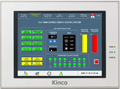
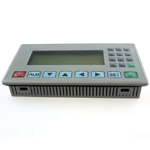




- Industrie-LCD-Display
-
Industrial Products
- DC Servo Drive
- AC Servo Drive
- PCB
- Siemens
- Switch Sensor
- Näherungsschalter
- Temperaturregler
- Schutzrelais
- Fiber Optic Sensor
- Encoder
- Fan
- other
- Heidelberg
- MITSUBISHI
- FANUC
- Siemens adapter
- Fujitsu connector
- Der Aufsichtsrat
- Board
- Contactor
- Circuit
- Omron
- Relais.
- Motortreiber
- power supply
- Cable
- Transformator
- HMI Touch-Glas
-
HMI-Vollautomat Ganze Einheit
- OMRON HMI Touch Panel
- Siemens HMI Touch Panel
- Mitsubishi HMI Touch Panel
- Allen-Bradley Automatisierung HMI Touch
- DELTA HMI Touch Panel
- EVIEW DELTA HMI Touch Panel
- KINCO DELTA HMI Touch Panel
- HITECH HMI Touch Panel
- WEINTECK HMI Touch Panel
- TECVIEW HMI Touch Panel
- WEINVIEW HMI Touch Panel
- PANASONIC HMI Touch Panel
- KYOCERA HMI Touch Panel
- SCHNEIDER HMI Touch Panel
- Module
- LCD Wechselrichter
- Membran Tastenfeld Schalter
- Winni Touch Screens
- Frequenzumrichter
- Servo Motor
- PLC
In the intricate world of embedded systems and portable electronics, the display module serves as the critical bridge between digital information and human interaction. Among the myriad of options available to engineers and product designers, the A029SAT01.0 AUO 2.9-inch TFT LCD module emerges as a specialized component, balancing compact form factor with capable performance. This article delves into a comprehensive analysis of this specific display module, moving beyond basic datasheet specifications to explore its architectural nuances, integration challenges, and ideal application landscapes.

We will dissect the technological foundations of the module, evaluate its optical performance in real-world scenarios, and provide practical insights for hardware integration and software optimization. Our goal is to furnish developers, procurement specialists, and tech enthusiasts with a deep, actionable understanding of where the A029SAT01.0 excels and how to leverage its capabilities to enhance end-product value, ensuring informed decision-making for your next innovative project.
Unpacking the A029SAT01.0: Core Architecture and Specifications
The A029SAT01.0 is a compact, high-integration display module built around an a-Si (amorphous Silicon) TFT (Thin-Film Transistor) LCD panel manufactured by AU Optronics (AUO). Its 2.9-inch diagonal size, typically offering a resolution of 1280(RGB) x 720 (720p), positions it in the realm of high pixel density for its class. The module integrates the LCD panel, driver ICs, backlight unit, and interface connectors into a single, ready-to-use unit.
Key specifications include its RGB or MIPI interface options, which dictate communication with the host processor. The module's outline dimensions, active area, and surface treatment (often glossy or anti-glare) are critical for mechanical design. Understanding this core architecture—the synergy between the TFT array, driving electronics, and the LED backlight system—is fundamental to appreciating its performance characteristics and integration requirements.
Optical Performance and User Experience Analysis
Beyond raw specs, the module's value is judged by its optical performance. The A029SAT01.0 typically boasts a high brightness level (often 500 nits or more), making it readable in various ambient lighting conditions, including indirect sunlight. Its contrast ratio and color gamut (covering a defined percentage of sRGB/NTSC) determine the vibrancy and depth of the displayed content.
Viewing angle is another crucial factor, with IPS (In-Plane Switching) or similar technology variants offering wide viewing angles without significant color shift or contrast loss. This section analyzes how these optical parameters—brightness, contrast, color fidelity, and viewing angle—translate into tangible user experience, particularly for applications requiring detailed graphics, prolonged viewing, or operation in challenging environments.
Hardware Integration: Interfaces and Power Considerations
Successfully embedding the A029SAT01.0 into a product requires careful hardware planning. The choice between parallel RGB and MIPI DSI interfaces has significant implications. RGB interfaces are simpler but require more pins and are susceptible to noise over longer traces. MIPI DSI is a high-speed serial interface, using fewer lines and offering better noise immunity, but demands a compatible host processor.
Power design is equally critical. The module requires separate power rails for the logic (VCC) and the LED backlight (LED+). The backlight driver circuit, whether constant current or PWM-controlled, must be designed to achieve desired brightness while ensuring efficiency and thermal management. Proper decoupling, signal integrity for high-speed lines, and ESD protection are non-negotiable for stable operation.
Software Driver Development and Optimization Techniques
The display is useless without proper software control. Initialization involves sending a precise sequence of commands to configure the internal controller's registers for timing, interface format, and power modes. Developers must adapt reference code from AUO or the IC vendor to their specific MCU or MPU platform.
Optimization focuses on performance and power. Techniques include using partial display refresh to update only changed areas, implementing deep sleep modes when the display is idle, and fine-tuning frame rates to balance smoothness with power consumption. Effective use of the frame buffer and potential hardware acceleration (like DMA) are key to ensuring fluid animation and freeing up CPU resources for other tasks.
Comparative Landscape and Alternative Solutions
To fully appreciate the A029SAT01.0's position, a comparative view is essential. How does it stack against similar-sized modules from competitors like Innolux or Tianma? Factors for comparison include cost, availability, optical performance, interface support, and mechanical footprint. Furthermore, designers should consider technological alternatives.
For instance, would an OLED panel of similar size offer better contrast and flexibility at a potentially higher cost and risk of burn-in? Or does the application demand a sunlight-readable transflective LCD instead? This analysis helps in making a technology-agnostic selection that best fits the product's performance requirements, budget, and lifecycle.
Ideal Application Scenarios and Market Fit
The A029SAT01.0 finds its ideal niche in portable, battery-powered devices that require a compact yet high-resolution display for rich graphical information. Prime application sectors include advanced handheld industrial instruments (like high-end multimeters or gas detectors), professional portable medical devices (for imaging or diagnostics), premium wearable tech beyond simple smartwatches, and compact human-machine interface (HMI) panels for embedded systems.
Its value proposition shines in products where space is at a premium, but visual clarity and information density are paramount. The module is less suited for cost-sensitive, high-volume consumer toys or applications requiring extremely low power in a monochrome, text-only format. Understanding this market fit ensures the component aligns with the product's commercial and technical goals.
FAQs: A029SAT01.0 AUO 2.9-inch TFT LCD Module
1. What is the typical resolution of the A029SAT01.0 module?It commonly features a 1280 x 720 (720p/HD) resolution, offering high pixel density on its 2.9-inch screen.
2. What interface options are available?The module is typically offered with either a parallel RGB interface or a MIPI DSI (Display Serial Interface).
3. Is this module suitable for outdoor use?With high brightness options (e.g., 500+ nits), it can be used in shaded outdoor conditions, but direct sunlight may still require a special optical bonded solution.
4. Does it have a touch screen function?The A029SAT01.0 is primarily a display module. Touch functionality (resistive or capacitive) is usually added as a separate overlay.
5. What is the operating voltage?The logic interface typically runs on 3.3V or 2.8V, while the LED backlight requires a separate driver, often starting from 3.6V upwards.
6. How do I obtain the datasheet and initialization code?These are usually provided by AUO or authorized distributors under a non-disclosure agreement (NDA) due to the proprietary nature of the driver IC timing.
7. Can it display video smoothly?Yes, with a proper MIPI or high-speed RGB interface and sufficient host processing power, it can support smooth video playback at its native resolution.
8. What is the expected lifespan of the backlight?The LED backlight typically has a long lifespan (often 20,000 to 50,000 hours), but this can be affected by drive current and operating temperature.
9. Are there known compatibility issues with specific processors?Compatibility is generally high with processors that support the required interface (RGB or MIPI). The main challenge is correctly implementing the initialization sequence and physical layer.
10. Where is this module commonly sourced from?It is sourced through electronics component distributors specializing in display modules or directly from AUO's sales channels, often requiring a minimum order quantity.
Conclusion
The A029SAT01.0 AUO 2.9-inch TFT LCD module represents a sophisticated solution for modern embedded designs demanding a blend of compact size, high resolution, and robust performance. Its integration is a multifaceted endeavor, requiring a harmonious blend of electrical design precision, mechanical consideration, and software finesse.
This deep dive underscores that selecting and implementing such a component is not merely a procurement task but a strategic engineering decision. By thoroughly understanding its architecture, performance envelope, and integration demands, developers can unlock its full potential, creating products that offer superior user interaction and stand out in competitive markets. Ultimately, the A029SAT01.0 is more than just a display; it is a vital conduit for information and experience in the palm of the user's hand.





