



















- Industrial display
-
Industrial Products
- DC Servo Drive
- AC Servo Drive
- Industrial board
- Siemens
- Switch Sensor
- Proximity Switch
- Temperature Controller
- Protection Relay
- Fiber Optic Sensor
- Encoder
- Fan
- other
- Heidelberg
- MITSUBISHI
- FANUC
- Siemens adapter
- Fujitsu connector
- Motherboard
- Board
- Contactor
- Circuit
- OMRON
- Relay
- Motor Driver
- power supply
- Cable
- Transformer
- HMI Touch Glass
-
HMI Full Machine Whole unit
- OMRON HMI Touch Panel
- Siemens HMI Touch Panel
- Mitsubishi HMI Touch Panel
- Allen-Bradley automation HMI Touch Panel
- DELTA HMI Touch Panel
- Proface HMI Touch Panel
- KINCO DELTA HMI Touch Panel
- HITECH HMI Touch Panel
- WEINTEK HMI Touch Panel
- TECVIEW HMI Touch Panel
- WEINVIEW HMI Touch Panel
- PANASONIC HMI Touch Panel
- KYOCERA HMI Touch Panel
- SCHNEIDER HMI Touch Panel
- Module
- lcd inverter
- Membrane Keypad Switch
- Zhiyan Customized Touch Screens
- Frequency Inverter
- Servo Motor
- PLC
In the intricate world of industrial and embedded display solutions, the choice of a single component can profoundly impact the performance, reliability, and user experience of an entire system. At the heart of countless mission-critical applications, from medical diagnostic equipment and industrial control panels to specialized point-of-sale terminals and transportation systems, lies a critical piece of technology: the Liquid Crystal Display Module (LCM). This article delves deep into one such pivotal component, the AA104XF02 by Mitsubishi, a 10.4-inch a-Si TFT-LCD module.
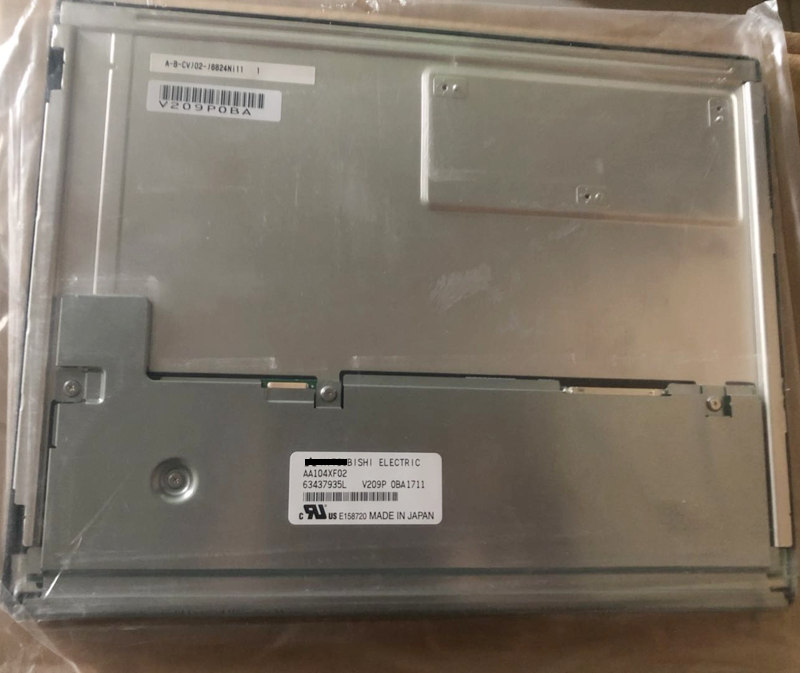
Our exploration goes beyond mere specifications. We will dissect the engineering rationale behind its XGA (1024x768) resolution and 123 PPI pixel density, examining why this particular combination remains a gold standard for specific industrial uses. We will analyze its construction, interface technology, and the environmental robustness it offers. By understanding the nuanced capabilities and ideal application scenarios of the AA104XF02, engineers, procurement specialists, and product designers can make informed decisions, ensuring their projects are built on a foundation of proven visual performance and durability.
Decoding the Core Specifications: XGA and 123 PPI in Context
The AA104XF02 is built around an XGA (1024 horizontal pixels x 768 vertical pixels) resolution. In an era of 4K and beyond, this may seem modest. However, for industrial and embedded applications, XGA represents a crucial sweet spot. It provides a significantly sharper and more detailed image than the older SVGA (800x600) standard, allowing for the clear display of complex data, schematics, and multiple information windows without overwhelming the system's processing resources or driving up cost unnecessarily.
Paired with this resolution on a 10.4-inch diagonal is a pixel density of 123 Pixels Per Inch (PPI). This metric is vital for readability at typical viewing distances for control panels or medical devices. A density that is too low results in a grainy, pixelated image, while an excessively high PPI can render small UI elements and text illegible without scaling, creating software compatibility issues. The 123 PPI of the AA104XF02 delivers crisp, legible character and graphic display, optimized for functional human-machine interaction rather than media consumption.
The Significance of a-Si TFT Technology for Longevity and Stability
The module utilizes Amorphous Silicon (a-Si) Thin Film Transistor (TFT) technology. This is a mature, highly reliable, and cost-effective production process for LCDs. For a industrial-grade component like the AA104XF02, the advantages of a-Si TFT are paramount. It offers excellent long-term stability and consistent performance over a wide operating temperature range, which is a non-negotiable requirement for equipment that may operate in factory or outdoor settings.
Unlike newer technologies like LTPS (Low-Temperature Polycrystalline Silicon) which prioritize ultra-high resolution and power efficiency for smartphones, a-Si TFT provides a robust foundation for displays that must remain operational for tens of thousands of hours. Its manufacturing yield is high, contributing to the module's overall reliability and making it a prudent choice for B2B and industrial applications where product lifecycles are long, and failure is not an option.
Module Construction: Beyond the Bare LCD Panel
It is critical to distinguish between a bare LCD panel and a complete LCD Module (LCM). The AA104XF02 is the latter—an integrated unit that includes the TFT glass panel, the driver ICs, the backlight unit (BLU), and the interface connectors, all assembled into a ready-to-use package. This "module" approach dramatically simplifies integration for OEMs. The complex tasks of bonding drivers to the glass and designing a uniform backlight system are already solved.
The construction typically features a sturdy metal frame that protects the delicate glass, provides electromagnetic shielding, and offers standardized mounting points. The integrated backlight, often utilizing LED arrays for longevity and low power consumption, is calibrated for consistent brightness and color temperature across the entire screen surface. This turnkey solution reduces development time, mitigates risk, and accelerates time-to-market for the end product.
Interface and Signal Integration: The LVDS Standard
The primary interface for the AA104XF02 is LVDS (Low-Voltage Differential Signaling). This is the industry-standard digital video interface for industrial displays of this class. LVDS transmits data using a differential method—sending complementary signals over a pair of wires. This makes it highly resistant to electromagnetic noise, which is ubiquitous in industrial environments filled with motors, relays, and power supplies.
LVDS allows for the high-speed transmission of the XGA signal from the system's graphics controller or single-board computer to the display module with minimal signal integrity loss over longer cable runs. For system integrators, working with a standard LVDS interface simplifies the design process, as compatible controller chips and cabling are widely available. It represents a robust, reliable, and predictable link in the signal chain.
Environmental Durability and Operational Parameters
The datasheet for a component like the AA104XF02 tells a story of resilience. Its specified operating temperature range (often from -20°C or -30°C to 70°C or higher) immediately signals its suitability for non-climate-controlled environments. Its storage temperature range is even wider. Furthermore, specifications regarding humidity resistance, vibration tolerance, and shock resistance are meticulously defined.
These parameters are not arbitrary; they are the result of design choices in materials, bonding processes, and component selection. The backlight's luminance (measured in nits) is specified to ensure readability under high ambient light. The viewing angles, typically wide (e.g., 80/80/80/80), ensure that the display content is visible from various positions, crucial for a control panel monitored by multiple operators. This environmental robustness transforms it from a simple display into a hardened industrial component.
Ideal Application Scenarios and Industry Use Cases
The technical profile of the AA104XF02 makes it an optimal solution for several demanding sectors. In industrial automation, it serves as the primary HMI for PLCs, CNC machine controls, and SCADA systems, where clarity, reliability, and 24/7 operation are essential. The medical device industry utilizes it in diagnostic equipment, patient monitors, and surgical tools, where accurate visual representation of data can be critical.
Other key applications include:
Transportation: Console displays in rail, maritime, or heavy vehicle contexts.
Point-of-Sale (POS) & Kiosks: For ruggedized self-service terminals in retail or outdoor settings.
Test & Measurement Equipment: Providing a stable interface for oscilloscopes, spectrum analyzers, and other precision instruments.
In each case, the module's blend of proven XGA resolution, industrial durability, and integrated module design offers a balanced, low-risk solution.
FAQs: AA104XF02 Mitsubishi 10.4" LCD Module
Q1: What does "LCM" stand for?A1: LCM stands for Liquid Crystal Display Module. It refers to a complete, integrated unit including the panel, drivers, backlight, and often a bezel/frame.
Q2: Is the 1024x768 resolution sufficient for modern applications?A2: For functional industrial HMIs, medical devices, and POS systems, XGA (1024x768) remains highly effective, offering a great balance of detail, compatibility, and cost.
Q3: What is the advantage of 123 PPI?A3: This pixel density provides excellent text and graphic legibility at typical arm's-length viewing distances for control panels, without causing software UI scaling issues.
Q4: Why is a-Si TFT technology used?A4: Amorphous Silicon TFT is a mature, reliable, and cost-effective technology ideal for applications prioritizing long-term stability and wide operating temperatures over ultra-high PPI.
Q5: What type of backlight does it use?A5: It almost certainly uses a long-life LED backlight system, known for low power consumption, durability, and consistent brightness.
Q6: What is the main interface?A6: The primary interface is LVDS (Low-Voltage Differential Signaling), the robust, noise-resistant standard for industrial digital video transmission.
Q7: Can it operate in harsh environments?A7: Yes. It is designed for industrial use, with specifications covering wide temperature ranges, humidity, and often resistance to vibration and shock.
Q8: Is this a drop-in replacement for other 10.4" XGA modules?A8: Not automatically. Mechanical dimensions, mounting holes, interface pinouts, and power requirements must be verified for compatibility.
Q9: What are typical applications?A9: Industrial HMIs, medical equipment, transportation consoles, ruggedized POS/kiosks, and test/measurement devices.
Q10: Where can I find the official specifications?A10: The definitive source is the official datasheet from Mitsubishi Electric or its authorized distributors, which contains all electrical, mechanical, and environmental specs.
Conclusion
The Mitsubishi AA104XF02 is far more than just a collection of specifications on a datasheet. It embodies a carefully engineered solution tailored for the rigorous demands of professional and industrial visualization. Its enduring relevance stems from a pragmatic combination of the XGA resolution standard, the reliability of a-Si TFT technology, the integration simplicity of the LCM format, and the signal integrity of the LVDS interface.
For designers and engineers, selecting a display module is a strategic decision that affects product performance, lifecycle cost, and user satisfaction. In contexts where unwavering reliability, environmental resilience, and functional clarity trump the latest consumer display trends, the AA104XF02 stands as a testament to proven, purpose-built technology. It serves as a critical, reliable window into the machine, enabling precise control and informed decision-making across a vast landscape of critical applications.





