























In the intricate world of electronic components, the display panel often serves as the critical interface between machine and user. Among the myriad of options available to engineers and product developers, specific industrial-grade modules stand out for their reliability and defined performance characteristics. This article provides an in-depth exploration of one such component: the 10.4-inch LCD TFT screen identified as NL6448BC33-54. This module, with its 640 x 480 pixel (VGA) resolution, represents a mature yet persistently relevant technology in a landscape increasingly dominated by high-definition displays.

We will dissect this LCD module beyond its basic datasheet specifications, examining its underlying TFT (Thin-Film Transistor) technology, the practical implications of its resolution and size, and its typical electrical and mechanical interface. The discussion will extend to its ideal application environments, contrasting it with modern alternatives, and provide crucial guidance on integration and sourcing. This analysis is designed not just to inform, but to empower designers and procurement specialists to make strategic decisions about when and why this specific display panel is the optimal choice for industrial, medical, or embedded systems.
Deconstructing the NL6448BC33-54: Core Technology and Architecture
The NL6448BC33-54 is built on a-Si (amorphous Silicon) TFT technology, a workhorse in the LCD industry. Each of the 640 x 480, or 307,200, pixels is controlled by its own dedicated transistor, enabling faster response times and superior image stability compared to older passive matrix designs. The "54" in its nomenclature often references a specific revision or performance grade, indicating characteristics like operating temperature range or backlight type.
This module typically incorporates a CCFL (Cold Cathode Fluorescent Lamp) backlighting system, which provides bright, uniform illumination suitable for a variety of lighting conditions. The panel itself is a digital RGB interface display, expecting specific timing signals to control pixel activation. Understanding this architecture is fundamental, as it dictates the required driving circuitry and power supply design, forming the foundation for all subsequent integration steps.
The VGA Format in a Modern Context: Advantages and Limitations
The VGA standard is universally supported by virtually all graphics controllers, from legacy systems to modern single-board computers, simplifying software and driver development. The limitation, of course, is in displaying complex graphics or high-detail imagery. This format excels in displaying structured data, schematic interfaces, and text-based information, making it a pragmatic choice for function-over-form applications.
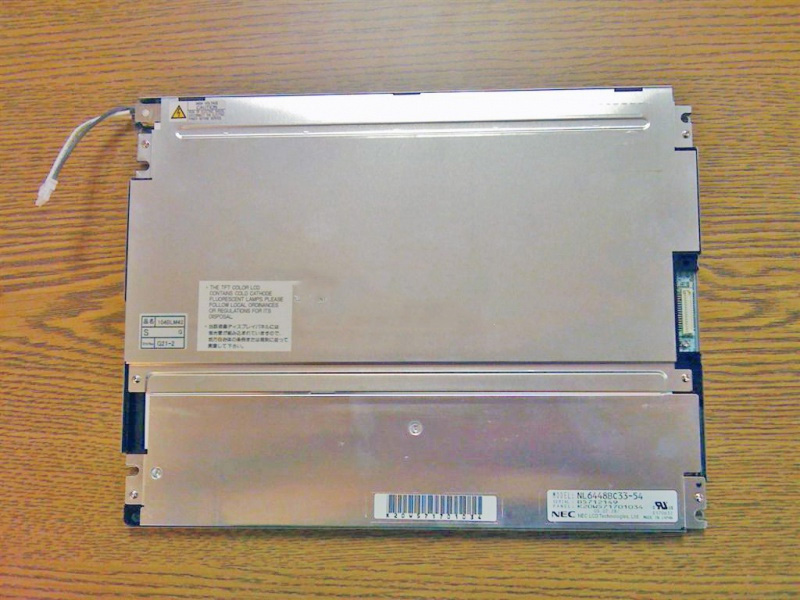
Electrical and Mechanical Interface Specifications
Mechanically, it features a standard LVDS (Low-Voltage Differential Signaling) or TTL interface connector, with a precise pinout for data, clock, power, and control signals. The physical dimensions, mounting hole patterns, and bezel design are fixed, requiring precise accommodation in the product enclosure. Furthermore, the presence of a CCFL backlight necessitates an inverter board and considerations for high-voltage isolation and EMI management.
Ideal Application Environments and Use Cases
Its technology is proven and stable, capable of operating over a wide temperature range (often specified for industrial grades). The use of CCFL backlighting, while less energy-efficient than LED, offers excellent brightness uniformity and a specific white point that can be advantageous. In these contexts, the module is a component within a larger, mission-critical system, where its predictable behavior is a key asset.
Comparison with Contemporary Alternatives: LED Backlighting and Higher Resolutions
The choice, therefore, is often one of system requirements versus cost and complexity. Legacy systems designed for CCFL VGA panels may find the NL6448BC33-54 a perfect drop-in replacement. New designs might opt for an LED equivalent for efficiency, but the VGA resolution may still be selected for its software simplicity and UI legibility, especially if the graphical demands are low.
Sourcing, Integration, and Long-Term Considerations
For long-term product support, developers must consider the end-of-life (EOL) status of the module and plan for potential future redesigns. This might involve designing a driver board that is adaptable to pin-compatible newer panels or selecting a form-factor-compatible alternative upfront. Understanding the supply chain for this specific part is as crucial as understanding its technical specifications.
FAQs: NL6448BC33-54 LCD Module
10. Where can I find a datasheet for this module?Datasheets can be sourced from electronic component distributors, manufacturer archives (like NEC, the original maker), or specialized display panel suppliers.





